HERE’S WHAT YOU CAN EXPECT
DURING YOUR COLONOSCOPY
- During the colonoscopy, your doctor will very carefully put a thin, flexible tube with a lighted fiber optic camera (called a colonoscope) into your rectum and colon. The colonoscope sends pictures of the inside of your colon to a video screen so your doctor can check for polyps (abnormal growths) or colon cancer. If your doctor does see a polyp, it can be removed during your colonoscopy.
- You will have an IV placed in a vein in your hand or arm so you can receive medicines and fluids. Right before the test begins, your doctor will give you a mild sedative that will help make you as comfortable as possible. As you lie on your side, your doctor will slowly and gently put the colonoscope into your rectum and up through your colon. You may feel some pressure, bloating, or cramping during the test.
- After your procedure, you will have to rest for a while until the effects of the anesthesia wear off. While you are resting, your doctor will talk to you about the results of your test and whether any polyps were removed. If a biopsy was performed, you can expect to get the results in a few days.
- Do not drive yourself home after your test. Ask a loved one or friend to go with you on the day of your exam.
Instructions and Lessons From Other’s Experiences
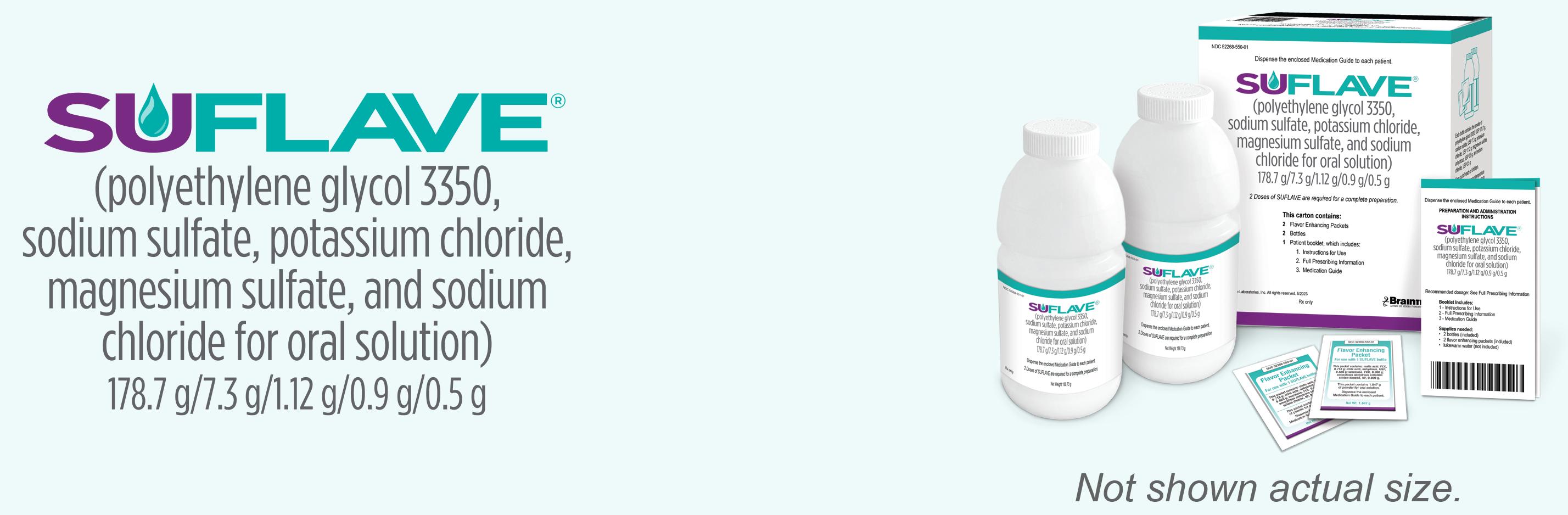
Be sure to follow your doctor’s instructions, and carefully read the information that comes with SUFLAVE®. Your doctor will tell you when it is time to begin taking SUFLAVE®.
SUFLAVE® is a split-dose (2-day) regimen. A total of 2 doses are required for complete preparation for colonoscopy in adults. You will take 2 bottles of liquid in two separate doses. One dose of SUFLAVE® is equal to one bottle plus one flavor-enhancing packet. An additional 16 ounces of water must be consumed after each dose of SUFLAVE®.
In clinical studies, the most common gastrointestinal adverse reactions were nausea, abdominal distension, vomiting, and upper abdominal pain. Call your doctor if you have any questions about taking SUFLAVE®.

Be sure to follow your doctor’s instructions, and carefully read the information that comes with SUTAB®. Your doctor will tell you when it is time to begin taking SUTAB®.
SUTAB® is a split-dose (2-day) regimen. A total of 24 tablets is required for complete preparation for colonoscopy. You will take the tablets in two doses of 12 tablets each. Water must be consumed with each dose of SUTAB®, and additional water must be consumed after each dose.
In clinical studies, the most common gastrointestinal adverse reactions were nausea, abdominal distension, vomiting, and upper abdominal pain. Call your doctor if you have any questions about taking SUTAB®.
 Listen to Jarett's experience
SUFLAVE® (polyethylene glycol 3350, sodium sulfate, potassium chloride, magnesium sulfate, and sodium chloride for oral solution)
Indications and Usage
SUFLAVE is indicated for the cleansing of the colon as a preparation for colonoscopy in adults.
ADDITIONAL IMPORTANT SAFETY INFORMATION
What is the most important information I should know about SUFLAVE?
SUFLAVE and other bowel preparations can cause serious side effects, including:
Serious loss of body fluid (dehydration) and changes in body salts (electrolytes) in your blood.
These changes can cause:
- abnormal heartbeats that can cause death.
- seizures. This can happen even if you have never had a seizure.
- kidney problems.
Do not take SUFLAVE if your healthcare provider has told you that you have:
- a blockage in your bowel (obstruction) or a problem with food moving too slowly through your intestines (ileus).
- an opening in the wall of your stomach or intestine (bowel perforation).
- a very dilated intestine (toxic colitis or toxic megacolon).
- problems with food and fluid emptying from your stomach (gastric retention).
- allergies to any ingredient in SUFLAVE.
What are the possible side effects of SUFLAVE?
- Changes in certain blood tests. Your healthcare provider may do blood tests after you take SUFLAVE to check your blood for changes. Tell your healthcare provider if you have any symptoms of too much fluid loss, including:
- vomiting
- dizziness
- urinate less than usual
- nausea
- stomach (abdominal) cramping
- trouble drinking clear liquid
- bloating
- headache
- vomiting
- dizziness
- urinate less than usual
- nausea
- stomach (abdominal) cramping
- trouble drinking clear liquid
- bloating
- headache
- Heart problems. SUFLAVE may cause abnormal heartbeats.
- Seizures.
- Ulcers of the bowel or bowel problems (ischemic colitis). Tell your healthcare provider right away if you have severe stomach-area (abdominal) pain or rectal bleeding.
- Serious allergic reactions. Get medical help right away if you have any signs and symptoms of a serious allergic reaction while taking SUFLAVE, including:
- difficulty breathing
- swelling of the face, lips, tongue and throat
- raised red patches on your skin (hives)
- skin rash
- itching
- difficulty breathing
- swelling of the face, lips, tongue and throat
- raised red patches on your skin (hives)
- skin rash
- itching
Before taking SUFLAVE, tell your healthcare provider about all of your medical conditions, including if you:
- have problems with serious loss of body fluid (dehydration) and changes in blood salts (electrolytes).
- have heart problems.
- have stomach or bowel problems including ulcerative colitis.
- have problems with swallowing or gastric reflux, or if you inhale food or fluid into your lungs when eating or drinking (aspirate).
- have a history of seizures.
- are withdrawing from drinking alcohol or from taking benzodiazepines.
- have a low blood salt (sodium) level.
- have kidney problems.
- are pregnant. It is not known if SUFLAVE will harm your unborn baby. Talk to your healthcare provider if you are pregnant.
- are breastfeeding or plan to breastfeed. It is not known if SUFLAVE passes into your breast milk. You and your healthcare provider should decide if you will take SUFLAVE while breastfeeding.
Tell your healthcare provider about all the medicines you take, including
- Prescription and over-the-counter medicines, vitamins, and herbal supplements.
- SUFLAVE may affect how other medicines work. Medicines taken by mouth may not be absorbed properly when taken within 1 hour before the start of each dose of SUFLAVE.
- Especially tell your healthcare provider if you take: medicines to treat a blood salt (electrolyte) imbalance, medicines for blood pressure, heart problems, kidney problems, or seizures, water pills (diuretics), non-steroidal anti-inflammatory drugs (NSAIDs), medicines for depression or other mental health problems, and laxatives. Do not take other laxatives while taking SUFLAVE
-
starch-based thickeners. For patients who have trouble swallowing, do not mix SUFLAVE with starch-based thickeners.The following medicines should be taken at least 2 hours before starting each dose of SUFLAVE and not less than 6 hours after taking each dose of SUFLAVE:
- tetracycline
- fluoroquinolone antibiotics
- iron
- digoxin
- chlorpromazine
- penicillamine
- tetracycline
- fluoroquinolone antibiotics
- iron
- digoxin
- chlorpromazine
- penicillamine
The most common side effects of SUFLAVE include:
- nausea
- stomach-area swelling (abdominal distension)
- Vomiting
- Upper stomach (abdominal) pain
- nausea
- stomach-area swelling (abdominal distension)
- Vomiting
- Upper stomach (abdominal) pain
These are not all the possible side effects of SUFLAVE.
To Report SUSPECTED ADVERSE REACTIONS, contact Azurity Pharmaceuticals, Inc. at 1-800-461-7449, or FDA at 1-800-FDA-1088 or www.fda.gov/MedWatch.
SUFLAVE® is a registered trademark of Azurity Pharmaceuticals, Inc.
PP-SUF-7061-US-EN-v1 03/26
SUTAB® (sodium sulfate, magnesium sulfate, and potassium chloride) tablets, for oral use
SUTAB is indicated for the cleansing of the colon as a preparation for colonoscopy in adults.
ADDITIONAL IMPORTANT SAFETY INFORMATION
What is the most important information I should know about SUTAB?
SUTAB and other bowel preparations can cause serious side effects, including:
Serious loss of body fluid (dehydration) and changes in body salts (electrolytes) in your blood.
These changes can cause:
- Abnormal heartbeats that can cause death.
- Seizures. This can happen even if you have never had a seizure.
- Kidney problems.
Do not take SUTAB if your healthcare provider has told you that you have:
- a blockage in your bowel (obstruction) or a problem with food moving too slowly through your intestines (ileus).
- an opening in the wall of your stomach or intestine (bowel perforation).
- a very dilated intestine (toxic colitis or toxic megacolon).
- problems with food and fluid emptying from your stomach (gastric retention).
- allergies to any ingredient in SUTAB.
What are the possible side effects of SUTAB?
- Changes in certain blood tests. Your healthcare provider may do blood tests after you take SUTAB to check your blood for changes. Tell your healthcare provider if you have any symptoms of too much fluid loss, including:
- vomiting
- dizziness
- urinate less than usual
- nausea
- stomach (abdominal) cramping
- trouble drinking clear liquid
- bloating
- headache
- vomiting
- dizziness
- urinate less than usual
- nausea
- stomach (abdominal) cramping
- trouble drinking clear liquid
- bloating
- headache
- Heart problems. SUTAB may cause abnormal heartbeats.
- Seizures.
- Ulcers of the bowel or bowel problems (ischemic colitis). Tell your healthcare provider right away if you have severe stomach-area (abdominal) pain or rectal bleeding.
- Serious allergic reactions. Get medical help right away if you have any signs and symptoms of a serious allergic reaction while taking SUTAB, including:
- swelling of your hands, face lips, mouth or tongue
- breathing problems
- raised red patches on your skin
- rash
- severe itching
- swelling of your hands, face lips, mouth or tongue
- breathing problems
- raised red patches on your skin
- rash
- severe itching
- Take SUTAB exactly as your healthcare provider tells you. Each SUTAB bottle contains a drying agent (desiccant) to keep the tablets dry. Do not swallow the desiccant. Remove and throw away the desiccant from both bottles the evening before your colonoscopy. Swallowing the desiccant by mistake has been reported and may cause choking or stomach and bowel problems.
Before taking SUTAB, tell your healthcare provider about all of your medical conditions, including if you:
- have heart problems.
- have stomach or bowel problems including ulcerative colitis.
- have problems with swallowing or gastric reflux.
- have a history of seizures.
- are withdrawing from drinking alcohol or from taking benzodiazepines.
- have a low blood salt (sodium) level.
- have kidney problems.
- are pregnant. It is not known if SUTAB will harm your unborn baby. Talk to your healthcare provider if you are pregnant.
- are breastfeeding or plan to breastfeed. It is not known if SUTAB passes into your breast milk. You and your healthcare provider should decide if you will take SUTAB while breastfeeding.
Tell your healthcare provider about all the medicines you take, including
- Prescription and over-the-counter medicines, vitamins, and herbal supplements.
- SUTAB may affect how other medicines work. Medicines taken by mouth may not be absorbed properly when taken within 1 hour before the start of each dose of SUTAB.
- Especially tell your healthcare provider if you take: medicines for blood pressure or heart problems, kidney problems, or seizures, water pills (diuretics), non-steroidal anti-inflammatory drugs (NSAIDs), medicines for depression or other mental health problems, and laxatives. Do not take other laxatives while taking SUTAB.
- The following medicines should be taken at least 2 hours before starting each dose of SUTAB and not less than 6 hours after taking each dose of SUTAB:
- tetracycline
- fluoroquinolone antibiotics
- iron
- digoxin
- chlorpromazine
- penicillamine
- tetracycline
- fluoroquinolone antibiotics
- iron
- digoxin
- chlorpromazine
- penicillamine
The most common side effects of SUTAB include:
- nausea
- stomach-area swelling (abdominal distension)
- Vomiting
- Upper stomach (abdominal) pain
- nausea
- stomach-area swelling (abdominal distension)
- Vomiting
- Upper stomach (abdominal) pain
These are not all the possible side effects of SUTAB.
To Report SUSPECTED ADVERSE REACTIONS, contact Azurity Pharmaceuticals, Inc. at 1-800-461-7449, or FDA at 1-800-FDA-1088 or www.fda.gov/MedWatch.
SUTAB® is a registered trademark of Azurity Pharmaceuticals, Inc.
PP-STB-7062-US-EN-v1 03/26
References: 1. Rex DK, Anderson JC, Butterfly LF, et al. Quality indicators for colonoscopy. Gastrointest Endosc. 2024;100(3):352-381. doi:10.1016/j.gie.2024.04.2905 2. Jacobson BC, Anderson JC, Burke CA, et al. Optimizing bowel preparation quality for colonoscopy: consensus recommendations by the US Multi-Society Task Force on Colorectal Cancer. Am J Gastroenterol. 2025;120(4):738-764. doi:10.14309/ajg.0000000000003287 3. Bhandari R, Goldstein M, Mishkin DS, et al. Comparison of a novel, flavor-optimized, polyethylene glycol and sulfate bowel preparation with oral sulfate solution in adults undergoing colonoscopy. J Clin Gastroenterol. 2023;57(9):920-927. doi:10.1097/MCG.0000000000001894 4. Di Palma JA, Bhandari R, Cleveland M, et al. A safety and efficacy comparison of a new sulfate-based tablet bowel preparation versus a PEG and ascorbate comparator in adult subjects undergoing colonoscopy. Am J Gastroenterol. 2021;116(2):319-328. doi:10.14309/ajg.0000000000001020 5. SUFLAVE® [package insert]. Woburn, MA: Azurity Pharmaceuticals, Inc. 6. SUTAB® [package insert]. Woburn, MA: Azurity Pharmaceuticals, Inc. 7. National Cancer Institute. Cancer stat facts: colorectal cancer. Accessed June 8, 2026. https://seer.cancer.gov/statfacts/html/colorect.html. 8. American College of Gastroenterology. Colorectal cancer: you can prevent it. Accessed June 8, 2026. https://webfiles.gi.org/links/committees/Public%20Relations/crc-awareness/crc_rackcard_2026.pdf. 9. American College of Gastroenterology. You can prevent colorectal cancer: don't let COVID-19 stop you. Accessed June 8, 2026. https://webfiles.gi.org/links/committees/Public%20Relations/21CRC-Rack-Card-Prevent-CRC-Dont-Let-COVID-Stop-You.pdf. 10. American College of Gastroenterology. 45 is the new 50! Accessed June 8, 2026. https://webfiles.gi.org/links/committees/Public%20Relations/crc-awareness/crc_45new50_trifold_2026.pdf.